
Back to Course List
Bloodborne Pathogens: Control Your Exposure
- Product ID
- clmibpce
- Training Time ?
- 30 to 60 minutes
- Language(s)
- English
- Video Format
- Standard Definition
- Required Plugins
- MasteryNet Player
- Lesson Interactions
- 9
- Quiz Questions
- 18
- Closed Captioning

Overview
Bloodborne Training that Meets OSHA Requirements
This bloodborne training is designed to meet OSHA's yearly training requirement for all workers. This course thoroughly covers methods employees should use to avoid a bloodborne pathogens exposure. In addition to covering Hepatitis B and HIV, this online safety training covers Universal Precautions, use of vaccines, and proper use of personal protective equipment. This course uses high quality video to fully cover all aspect of bloodborne training. All workplace safety training curriculums should include bloodborne training in their health and safety training library.
 This course is in the Advantage™ format, to read about Advantage™ features click here.

- Rich multimedia presentation with interactions and quiz
- Print certificate and wallet card
- You have 30 days to complete the course

Workplaces
Audience
All workers.
Topics
The course presents the following topical areas:
-
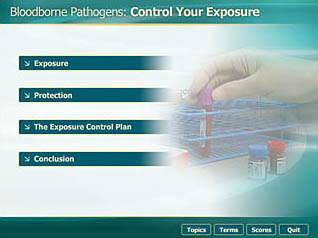
Exposure
- Defining bloodborne pathogens
- Body fluids that can cause infection
- Routes of entry
- Most common bloodborne diseases
- Risks of infection
-
Protection
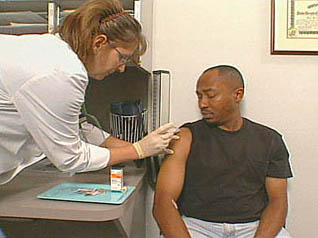
- Vaccines
- Universal Precautions
- Using Personal Protective Equipment (PPE)
- Removing Personal Protective Equipment (PPE)
- Cleaning
- Waste removal
-
The Exposure Control Plan
- The written Exposure Control Plan.
- Hepatitis B vaccinations
- In the event of an exposure incident
- Confidential medical information
Intended Performance Outcomes
Upon successful completion of this course you will be better prepared to:
-
Avoid exposure to bloodborne pathogens.
- Define bloodborne pathogens.
- Identify body fluids that can cause infection.
- List ways a disease-carrying pathogen can enter your body.
- Select the three most common bloodborne diseases.
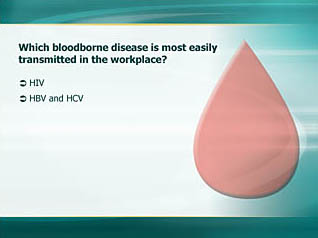
- Choose the most easily contracted bloodborne diseases.
-
Protect yourself from bloodborne pathogens.
- Select bloodborne diseases that can be controlled with a vaccine.
- Recall the most common form of Universal Precaution.
- Agree that single latex gloves will not always provide enough protection.
- List PPE that will protect your from bloodborne Pathogens.
- Describe the process to properly remove latex gloves.
- Recognize the need to wash contaminated clothing separately.
- Select an appropriate cleaning solution for contaminated surfaces.
- Describe the best way to clean up contaminated broken glass.
-
Utilize the Exposure Control Plan in your workplace.
- Identify workplaces requiring a written Exposure Control Plan.
- Define an Exposure Control Plan.
- Identify the post-evaluation and follow-up required for any exposure incident.
- State the possible outcomes of divulging confidential medical information.
- Recall that Hepatitis B vaccinations must be available for all employees at risk of exposure.
© Mastery Technologies, Inc.

